 Animal Bonds


A slightly unusual path
My career has taken me through some surprising places, all of them connected by maths in ways most people wouldn't guess. In my early twenties I was a croupier, calculating odds and payouts at speed in front of strangers (17s are still my favourite times table). After that I moved into finance for several years. And then I moved into software development, which, as anyone who has built software for real will tell you, is far more mathematical than the job title lets on.
The thread running through all of it is the same. When you can do the basic arithmetic in your head without thinking, you have room left to think about the actual problem. When you can't, every problem is harder than it needs to be.
Why I built Animal Bonds
The idea came from watching my own son.
He's doing well at school. By every measure, he's on track and his teachers are pleased. But I started noticing something: he was still working out his number bonds on his fingers, under the table, when he thought no one was looking. He had the answers, he just didn't have them automatically. Every small calculation cost him a little bit of mental effort he could have been spending on something harder.
I knew exactly how much of a difference automatic recall had made for me, and I couldn't quite believe there wasn't already a tool doing this specific job well. I looked at what was out there. Lots of clever products, lots of engaging games, but nothing that I felt really focused on the fluency itself, with honest measurement and properly useful data for teachers. Most of them ranked children on points and streaks, which tell you a child is logging in but not whether they're actually getting faster.
So I decided to build it.
Built with a real child in the room
I was already developing some other software at the time, and my son had been helping me test things. We sat down together and started designing a game that would be genuinely fun to play but would only work on the bits he was weakest on. He's been my best debugger, brutally honest about what was boring, what was confusing, and what made him want to keep playing. The early prototypes were shaped, sometimes quite forcefully, by a primary-school-age opinion in the room.
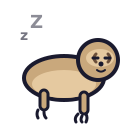
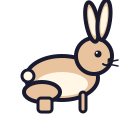
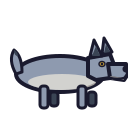
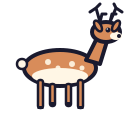
That's how Animal Bonds came to be. The racing mechanic, the animal ranks, the ghost runner that shows children how they're doing against their last attempt: all of it was tested on a child who would tell me, with no diplomatic filter, when something didn't work.
What's coming next
Animal Bonds is the first of several. I'm working on more games that target other specific gaps in primary education, with the same approach of honest measurement, real diagnostic data, and a single thing done properly rather than a sprawling everything-app. They all run on Curious Prism, one shared schools platform, so when a new game is ready we can simply switch it on and every existing pupil, teacher, and parent account works with it straight away. No re-onboarding, no new logins. More to come.
When I'm not doing this
You'll find me on a beach or in a forest somewhere with my kids, painting, building things in the garage, or (my family will roll their eyes at this) actively looking for problems so I can have the fun of thinking about how to solve them. Animal Bonds started as one of those problems. It just happened to be one worth turning into a company.
Thanks for reading. If you'd like to try the game, there's a no-sign-up demo on the homepage. If you're a teacher or a head and want a proper walkthrough, I'd love to hear from you.
Andy